Quant vs. Qual: How Gen AI Scales Consumer Insights


The iPhone almost didn't happen the way we know it. Apple's own market research caught what BlackBerry and Nokia missed and built a device people didn't yet know they wanted. At Socialtrait, we see the same split today: quantitative research shows what's happening at scale, while qualitative research explains why, and generative AI now speeds up both.
Clunky devices, small physical keyboards, and a lack of integration between different functions like phone, email, and multimedia were common frustrations among smartphone users in the mid-2000s. Without market research, Apple would have released a product similar to the ones already on the market, like BlackBerry, Nokia, or Palm. Or, they would have improved its existing product lines (iPods, Macs) without innovating for the smartphone market.
Well, what did Apple’s market research reveal? It revealed that smartphone users were increasingly relying on their devices for more than just calls and texts. Apple’s iPhone disrupted the mobile industry with its iconic touch interface, and its integration of music, apps, and internet functionality, creating a broader ecosystem, and more importantly, the iPhone. Today, with a network of $3.439 trillion, it is the world’s most valuable company by market cap. Most of this success is owed to market research, and their gumption to innovate.
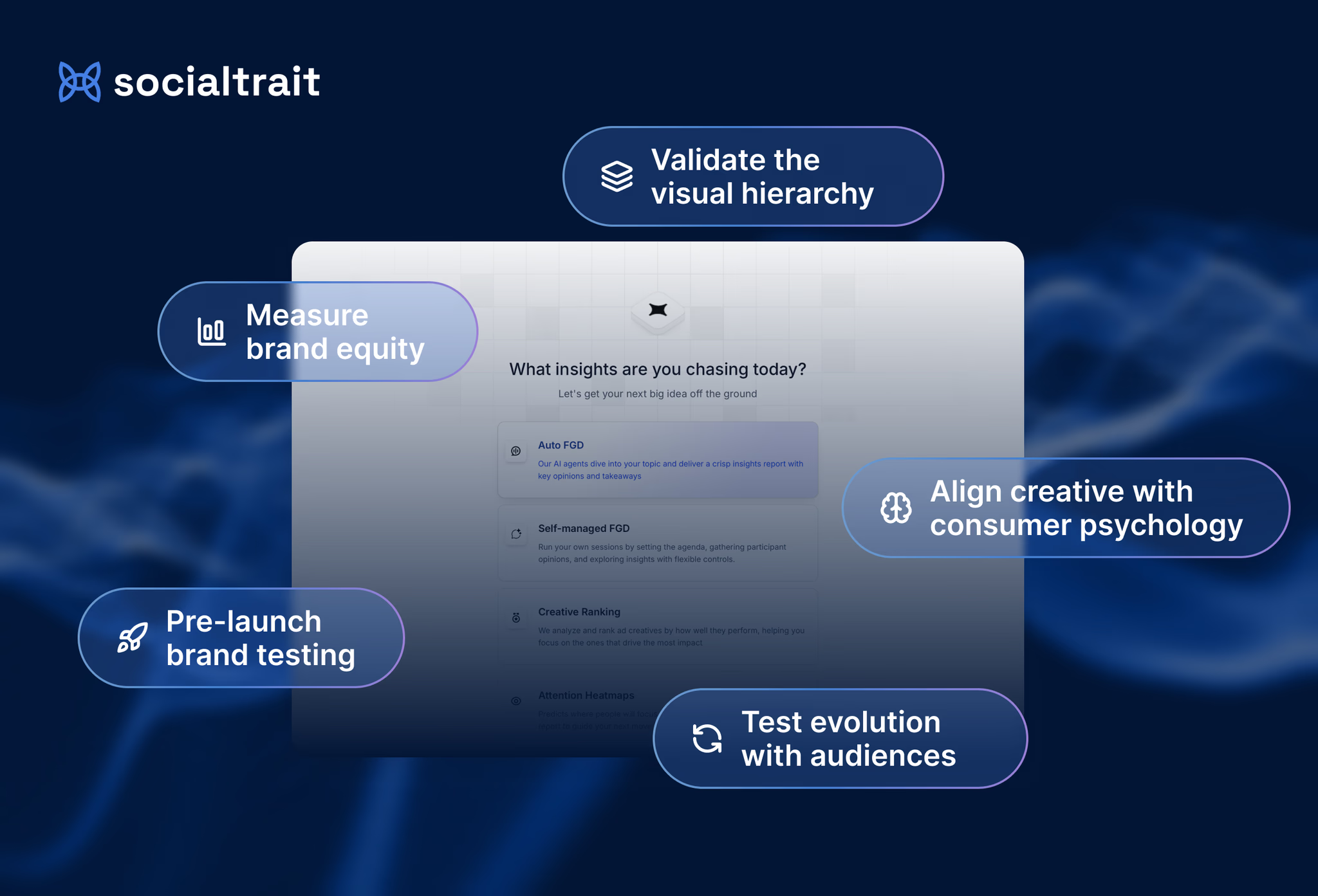
Through AI-powered virtual communities, Socialtrait helps businesses understand their consumer’s unique consumer behaviors and trends. It offers a deep dive into customer needs and preferences. From pilot testing a web series to concept testing of marketing campaigns, Socialtrait’s AI-powered research methods help businesses across industries.
This article looks at quantitative vs. qualitative research and shows how Gen AI enhances these methods.
Quantitative research focuses on measurable data, and statistical analysis, and follows an impartial approach. It is used to forecast outcomes, examine causal links, identify trends and averages, and extrapolate findings to broader demographics. It is the opposite of qualitative research, where non-numerical data like audio, video, and text, is collected and analyzed.
Key Characteristics
Measurability: Since it is quantitative in nature, the data gathered through this method is measurable
Large Sample Size: One of the biggest advantages of quantitative research is that you can use larger sample sizes
Structured Research Methods: It collects data from standardized research instruments like surveys and questionnaires. This ensures that the data is collected systematically and is valid and reliable.
Use of Statistical Analysis: Quantitative research uses statistical analysis to analyze the data. It helps researchers to test the hypothesis and determine whether the results are statistically significant.
Reusable Outcome: The outcome of quantitative research can be used several times.
Close-ended Questions: They are more reliable since they are more specific.
Numerical Outcome: A quantitative research outcome is always in numerical form. Numerical outputs are easy to understand and read.
Common Methods of Quantitative Research:
Online Quantitative Surveys:
Online surveys are an effective way to collect data from a large number of people. They are easy to send out and are also convenient for the recipient to complete and submit. It can also be sent anonymously.
Probability sampling is one of the popular methods for finding respondents for online surveys, where respondents are selected at random. Using this method, everyone within the population has an equal chance of getting selected.
Interviews:
Interviews, in-person, or through online tools, are a popular means of collecting data. You get to hear directly from the respondent. It is more valuable since it is in a personal one-to-one setting. In structured interviews, the interviewer can set the pace, making sure that there is ample time spent on each question.
Observations:
In quantitative observations, researchers will record the number of times people commit to a particular action. It could be choosing product A over product B, crossing a road within a particular time frame, and the number of walk-ins to a particular store.
Secondary Data Resources:
Here, existing research is reviewed to see how they can be of help. Some of the secondary data resources are government records, company databases, existing reports, research publications, journals, case studies, magazines, books, etc.
Advantages of Quantitative Research:
- It helps us to better identify the root cause behind certain consumer behaviors
- It does not ask participants to divulge their personal information as it doesn’t require them to be named or identified.
- Quantitative research processes needn’t be directly observed, freeing up researchers to focus on important activities
- It is verifiable and enables other researchers to duplicate the methodology
- It can capture vast amounts of data quicker than other research activities
Limitations of Quantitative Research:
- It’s difficult to explore complex phenomena in detail
- It is vulnerable to various biases that can affect the validity of the research
- Inappropriate sampling methods or imprecise measurements can lead to inaccurate results
- It can be expensive in case of large sample sizes
Qualitative research methods use in-depth questionnaireing of respondents based on their responses. It uses psychology, sociology, and anthropology to understand their motivations and feelings.
Key Characteristics of Qualitative Research:
Natural Settings: Respondents are studied in their natural environments to get real information.
Multiple Sources of Data: They collect data from various sources such as documentation, observation, interviews, etc.
Researcher Plays an Important Role: The researcher plays a crucial role since they are responsible for choosing the research method and for making a plan to conduct effective research.
Reflexivity: In qualitative research, the researchers share everything about the research, its purpose, and their background, with the participants. This makes them participate more enthusiastically.
Holistic Account: The researcher focuses on different perspectives and determines the factors involved in the research to paint a larger picture.
Common Methods of Qualitative Research:
One-on-one Interviews:
Here, an interview is carried out with one person at a time. It provides a great opportunity to gather meaningful data by asking detailed questions with follow-ups.
Focus Groups:
This involves a limited number of respondents from within your target audience. It is an expensive method and is usually used in complex scenarios.
Grounded Theory:
The theory aims to provide the reasons, theories, and explanations behind an event. It’s mainly used to conduct customer satisfaction surveys to explain why a customer purchases a particular product.
Phenomenology:
It describes how individuals experience or feel about a particular event.
Digital Ethnography:
Its objective is to study the individual’s behavior, interactions, and social dynamics within online spaces.
Advantages of Qualitative Research:
- Since it explores the “why” behind things, it lets you analyze thoughts, feelings, and behavior
- It provides deeper insights as it allows people to expand on how they are feeling
- It lets you adapt your questions in real time, depending on the information you are gathering
Limitations of Qualitative Research:
- Qualitative research is in-depth, but you will be only dealing with small sample sizes
- Since the sample size is small, you can’t say for sure that the result represents the views of a larger population
- It doesn’t offer anonymity, and there are topics that not everyone will be comfortable sharing in a one-to-one setting or a focus group
- The people you select for the research might have their own biases
Today, generative AI has become the mainstay for a variety of use cases in almost every industry. It is especially true for the market research industry where businesses have embraced them. Despite its immense potential in market research, there are challenges, mainly ethical considerations. By following ethical and responsible AI practices, market researchers can still use gen AI and ensure transparency and fairness.
Let’s look at a few use cases of Gen AI in market research:
- Data Collection: Gen AI enhances data collection agility and efficiency in market research
- Data Visualization and Reporting: It helps with insight summarization, rapid reporting, and visual-based reporting. This significantly enhances speed-up reporting and visualization.
- Data Analysis: It enables researchers to tap into customer reviews, and forums, and analyze at scale to generate insights
- Data Management: It streamlines data management tasks like data quality monitoring, automated data cleaning, and PII data removal
How does Gen AI Integrate With Quantitative and Qualitative Research:
Gen AI in consumer research contributes to quantitative research by:
- Gen AI models can quickly analyze large datasets, generate predictions, and spot patterns that human analysts might miss
- It cleans and organizes raw data from different sources to ensure accuracy for statistical analysis
- It leads to more reliable data collection by predicting how certain questions will influence participant responses
- These AI models can simulate scenarios and provide real-time forecasts, helping in hypothesis testing and decision-making
Gen AI in consumer research contributes to qualitative research by:
- It analyzes qualitative data like interview transcripts, and social media posts, and recognizes themes, sentiments, and emotions
- It can generate reports and unearth key insights from qualitative data. Thanks to this, researchers don’t have to manually sift through data
- It can analyze sentiments of written and spoken content
Online AI personas as virtual communities brings a distinct set of benefits, which is different from traditional online communities. Let’s look at some of its key advantages.
- These AI-powered personas can be programmed with deep knowledge in specific areas
- The virtual communities mirror real-world behaviors by simulating realistic consumer interactions and responses
- The virtual communities perform qualitative research at a large scale and quantify behavioral drivers, thereby allowing marketers to make data-backed decisions confidently
- The AI person in these virtual communities can simulate complex interpersonal or business scenarios
Advantages of using Gen AI in Consumer Research
Speed and Efficiency:
Gen AI can gather and process massive datasets in seconds. It can run complex statistical models, analyze open-ended responses, and generate reports instantly. Producing real-time consumer insights allows businesses to respond to consumer feedback or market shifts immediately.
Cost-Effectiveness:
It automates labor-intensive tasks like survey distribution, data entry, and preliminary analysis, therefore significantly cutting labor costs. By identifying the most important metrics to focus on, it reduces wasted resources on the wrong data.
Reduction in Research Fatigue and Sampling Errors:
Gen AI can design adaptive questionnaires that adjust based on previous answers, thereby minimizing research fatigue. It targets the right sample size and demographics based on past data and by identifying patterns.
Deeper Insights Through AI-Based Simulations:
It goes beyond traditional market research by running simulations and generating scenarios for more predictive insights. The AI models simulate different market conditions to predict how different strategies perform under changing conditions.
Related blogs





Level 3, 102 Victoria St, Carlton VIC 3053 Australia
1 Denison St Level 16, North Sydney, NSW 2060, Australia
95 Third Street, 2nd Floor, San Francisco, CA 94103